Physical Address
Starlets Road, P.O. Box M 326, Accra, Ghana
Physical Address
Starlets Road, P.O. Box M 326, Accra, Ghana
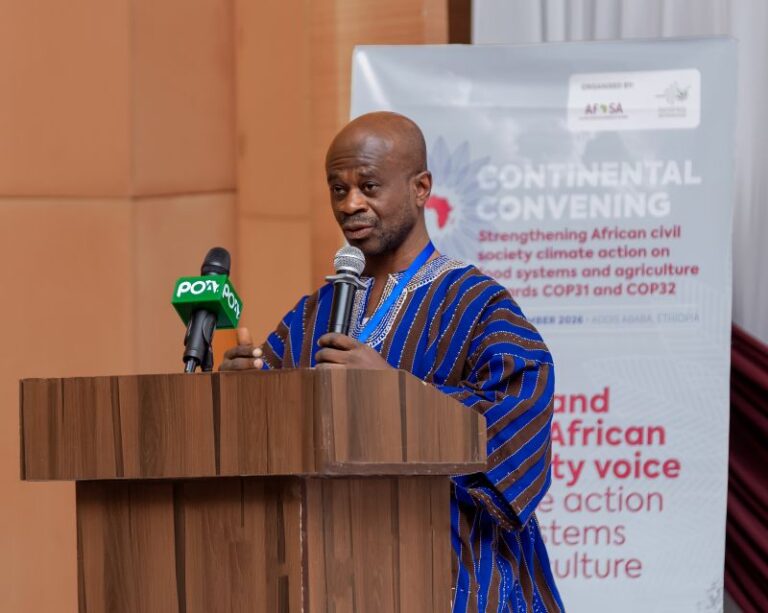
Addis Ababa, Ethiopia, Aug. 10, AGN — Africa must use the upcoming UN climate summits to secure concrete action on adaptation, food security and climate finance, rather than settle for new promises, Chairman of the African Group of Negotiators (AGN) on Climate Change, Nana Dr. Antwi-Boasiako Amoah, has said.
Delivering a keynote address at the Continental Convening on Strengthening African Civil Society Climate Action on Food Systems and Agriculture Towards COP31 and COP32 in Addis Ababa, he warned that climate change was already threatening livelihoods across the continent through failed rains, floods, livestock diseases, food price hikes and declining agricultural productivity.
With COP31 scheduled for Antalya, Türkiye, in November 2026 and COP32 set to be hosted in Addis Ababa in 2027, Dr. Amoah said Africa faced an immediate opportunity to shape global climate negotiations around its development priorities.
“A COP held in Africa does not automatically deliver for Africa,” he said. “It must be shaped by African priorities, evidence and solutions, and it must improve lives beyond the conference halls.”
The AGN Chair described food systems as the point where climate policy intersects most directly with daily life, affecting everything from farming and fisheries to nutrition, health, trade and employment.
He noted that although the Paris Agreement had established a framework for addressing climate change, major gaps remained between climate ambition and implementation, adaptation needs and available finance, and global commitments and realities on the ground.
Dr. Amoah stressed that adaptation must remain Africa’s foremost priority, arguing that climate impacts often reach households first through food and water insecurity.
Drawing from Ghana’s experience, he said many farmers were increasingly unable to predict seasonal rainfall patterns, leading to crop failures and financial losses.
“For that farmer, adaptation is not an abstract policy category,” he said. “It is reliable climate information, the right seed, access to water, extension support and finance at the right time.”
He highlighted the vast funding shortfall facing developing countries, noting that adaptation needs are projected to reach between US$310 billion and US$365 billion annually by 2035, while international public adaptation finance stood at only US$26 billion in 2023.
The AGN Chair called for climate financing mechanisms to be simplified so resources could reach farmers, fishers, women’s groups, youth enterprises and local institutions more directly.
“Too much finance stops at the international, national or project-design level,” he said. “The route from a global fund to a village must become shorter, simpler and less costly.”
Dr. Amoah outlined seven priorities for Africa at COP31, including protecting the balance between adaptation and mitigation under the Paris Agreement, securing stronger outcomes on agriculture and food security, increasing adaptation finance, strengthening loss and damage support, and ensuring climate-related trade measures did not undermine Africa’s development ambitions.
He also set out six expectations for COP32 in Addis Ababa, including a continent-wide adaptation delivery package, stronger support for climate-resilient food systems, improved direct access to climate finance, greater alignment between climate and development plans, enhanced African technological innovation, and stronger accountability mechanisms.
He urged African civil society organisations to develop a unified continental position, backed by evidence and practical policy demands, to influence negotiations before and during both conferences.
“The AGN needs a civil society that is organised, informed and bold,” he said. “African civil society needs negotiators who listen, explain and remain accountable.”
Dr. Amoah concluded by reminding delegates that the true measure of climate negotiations lay not in the language of agreements and technical frameworks, but in their impact on ordinary people.
“The farmer waiting for rain does not experience climate change as an acronym,” he said. “Our responsibility is to make sure that what happens in the negotiating rooms eventually changes what happens on the farm, in the market, in the fishing community and around the family table.”
The three-day Addis Ababa convening brings together government representatives, civil society organisations, farmers’ groups, researchers, women and youth networks, and development partners to build a common African position on food systems and climate action ahead of COP31 and COP32.
END/AGN